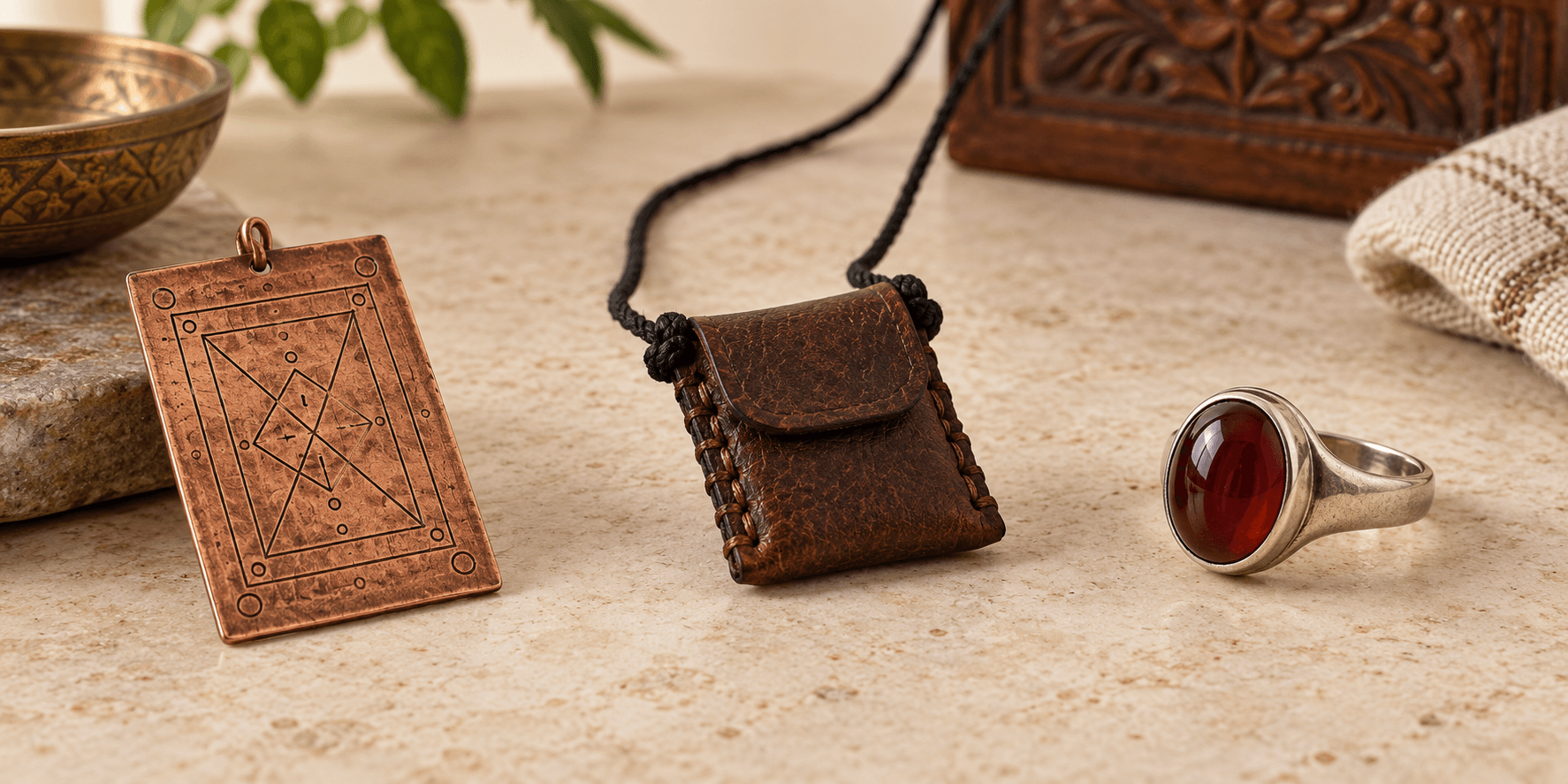
Illustration: AI-generated examples of a metal talisman, an amulet pouch and a gemstone ring. These are not photographs of any individual’s or organisation’s products.
The name “Ruqya Shariyya” alone does not establish that a practice follows Islamic teachings. Ask what is recited, who is being called upon, which objects are prescribed and what powers are claimed for them. Reciting the Qur’an alongside another practice does not automatically make that practice permissible.
This guide explains how to assess claims involving talismans, taweez, amulets, protective stones and practices described as thalsamath or “ism treatment”. In Kerala, related objects may be called elas or thakidu. It discusses methods and claims, without making allegations against any named person or institution.
Does a new name make a practice authentic?
Labels such as “Qur’anic healing”, “Islamic treatment” and “Ruqya Shariyya” are not substitutes for evidence. Whatever a practice is called, its words, beliefs and actions need to be examined against the Qur’an and Sunnah.
“We use the Qur’an” is only part of an answer. If a session also includes unexplained symbols, secret invocations or objects said to possess special powers, those elements need their own explanation.
What is Ruqya Shariyya?
Ruqya involves seeking healing and protection from Allah through Qur’anic recitation and authentic supplications. Permissible supplications with a clear meaning and no shirk may also be used. Neither a practitioner nor an object should be regarded as having an independent power to heal.
In Sahih Muslim 2200, the Prophet ﷺ asked people to present their incantations and explained that ruqya is acceptable when it contains no shirk. The content matters, not merely the label.
Thalsamath and “ism treatment”: questions to ask
These terms may be used differently by different people. Rather than deciding from a name alone, establish the actual words, inscriptions, symbols and beliefs involved.
Statements such as “this is a secret ism”, “you do not need to know its meaning” or “you must not ask questions” do not establish a religious basis. Ask what is being recited, what it means, who is being invoked and what evidence supports any prescribed ritual.
Calling upon Allah by His names is different from attributing special powers to unexplained formulas. Arabic lettering alone does not prove that an inscription is Qur’an or an authentic supplication.
Taweez, amulets and metal talismans: are they all the same?
Find out what an amulet contains, why it is worn and what the wearer is told to believe about it. Unknown invocations or appeals involving shirk cannot be justified simply by mentioning the Qur’an.
Scholars have differed specifically over amulets containing only Qur’anic text. That disagreement should not be confused with approval of unknown formulas or invocations involving shirk. Ask a qualified, trustworthy scholar to examine the actual contents of a particular object. Do not judge a person’s faith merely from the appearance of an object.
Can a gemstone guarantee protection or business success?
Claims that a ring or stone prevents the evil eye, brings luck, grows a business or removes “negative energy” require evidence. Advertising and personal success stories do not establish those powers.
Wearing a stone as decoration is different from attributing unseen protective powers to it. Something good happening after someone wears a ring does not, by itself, show that the ring caused it. Religious claims require a sound religious basis, and health claims require reliable evidence.
Seven questions before choosing a ruqya practitioner
1. Is the recitation Qur’an or a permissible supplication with a clear meaning?
2. Are healing and protection sought from Allah?
3. Will the practitioner explain the words and the basis for their instructions?
4. Are unexplained symbols or objects assigned unsupported powers?
5. Are guaranteed cures or fixed deadlines for results promised?
6. Does anyone claim unseen knowledge to accuse a particular person of causing sihr?
7. Are you encouraged to learn self-ruqya and continue necessary healthcare?
Learn self-ruqya without fear
You do not need to depend on another person for every recitation. Sahih al-Bukhari 5017 describes the Prophet ﷺ reciting Al-Ikhlas, Al-Falaq and An-Nas before sleep, blowing into his hands and wiping his body.
Malayalam readers can use our self-ruqya guide, dua and dhikr guide and introduction to ruqya. For individual guidance, contact Ruqiya Wellness.
Continue necessary healthcare
Ruqya is a spiritual practice, not a replacement for medical assessment or necessary treatment. Symptoms or reactions during recitation alone do not establish jinn involvement, sihr or the evil eye. Discuss medication changes with the clinician treating you.
Frequently asked questions
Does Qur’anic recitation make every accompanying practice permissible?
No. Other rituals and the beliefs behind them must be assessed separately, even when Qur’an is also recited.
Is “Ruqya Shariyya” a certificate of authenticity?
No. Examine the actual method, words and supporting evidence. A clear explanation should be available when you ask.
Does feeling better prove that a method is religiously permissible?
Feeling relief is not, by itself, evidence of religious permissibility. A claimed result and the permissibility of the method are separate questions.
Can I learn ruqya without buying a talisman?
Yes. Qur’anic recitation and permissible supplication do not require buying a talisman or gemstone. Start with reliable teaching and ask a qualified scholar about anything you do not understand.
Look beyond the name. Understand the method. Ask for evidence. Rely on Allah.
